

The not-for-profit freight factoring model emerged in 1958 when small carriers faced 30-60 day payment terms that threatened their ability to fuel trucks and pay drivers. Traditional banks wouldn’t finance freight invoices, and the few factoring companies that existed charged rates exceeding 5% while locking carriers into multi-year contracts with hidden fees.[3] A group of East Coast truckers solved the problem by creating their own cooperative — Transport Clearings East — where members would collectively purchase each other’s invoices at cost, returning any surplus as patronage dividends.
Written by TCE Editorial Team — Freight industry professionals at Transport Clearings East, Inc., a not-for-profit trucking factoring cooperative founded in 1958. Governed by five board directors elected by member-carriers.
Why Did Carriers Create a Not-for-Profit Factoring Cooperative in 1958?
Trucking companies in the late 1950s faced a cash flow crisis that threatened the industry’s growth during the post-war economic boom. Brokers and shippers routinely paid invoices 30 to 60 days after delivery, while carriers needed immediate funds to cover fuel, driver wages, maintenance, and insurance.[3] The few for-profit factoring companies operating in 1958 exploited this desperation with rates ranging from 5% to 8% per invoice, mandatory long-term contracts, and additional fees for credit checks, wire transfers, and account management.
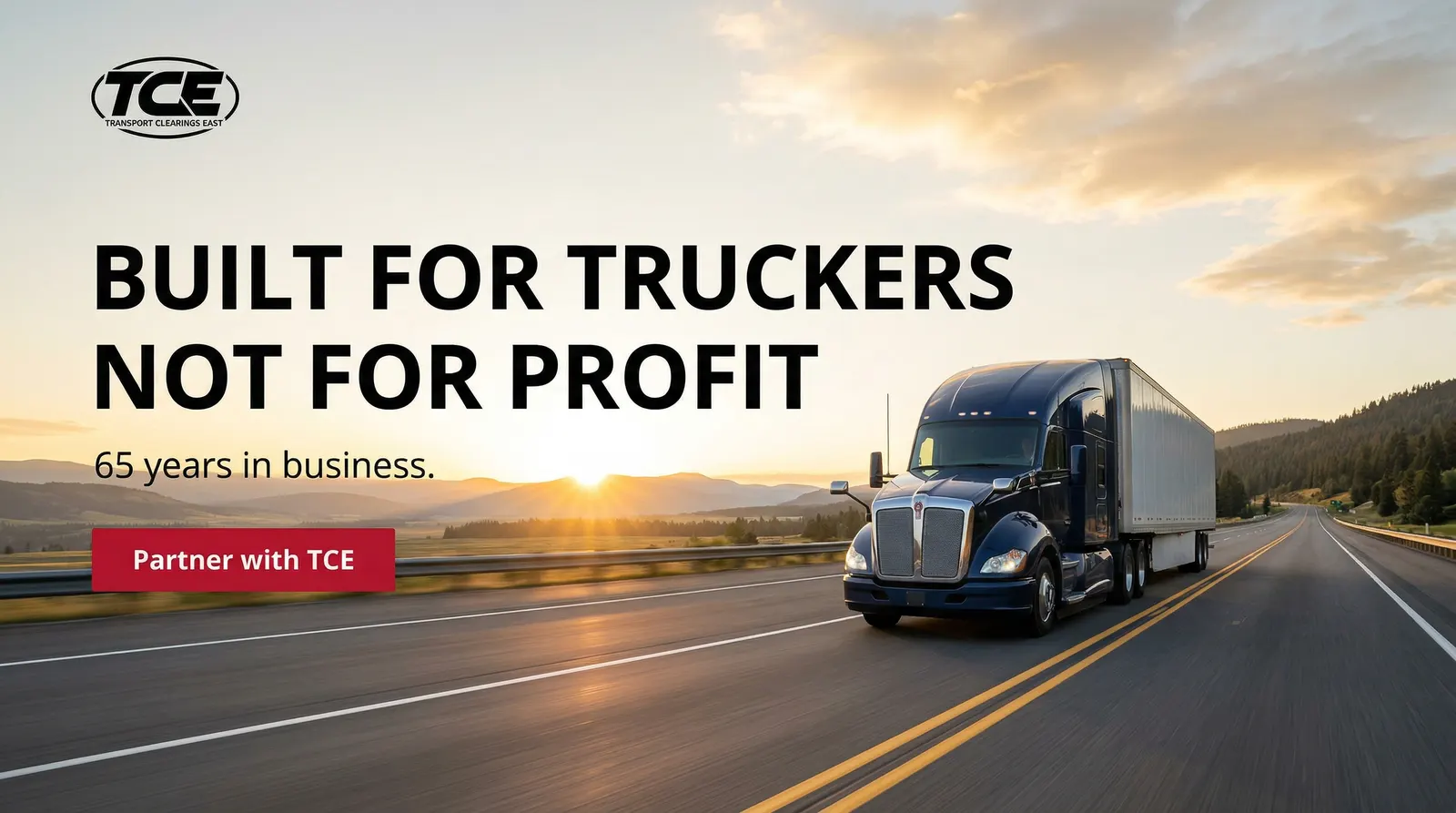
A coalition of small carriers in the Mid-Atlantic region recognized that pooling their invoices would create sufficient volume to operate a factoring service at cost. They incorporated Transport Clearings East as a not-for-profit cooperative, where each member became a part-owner with voting rights.[1] The cooperative structure meant that any revenue exceeding operational costs would be returned to members as patronage dividends rather than distributed to outside investors. This fundamentally different business model aligned the factoring company’s success with carrier profitability — a stark contrast to for-profit competitors whose revenue depended on maximizing fees.
The founding members established three core principles that still govern TCE today: no long-term contracts that trap carriers in unfavorable terms, no minimum volume requirements that exclude small operators, and transparent pricing with rates calculated to cover costs plus a modest reserve fund.[2] These principles directly addressed the predatory practices that made for-profit factoring inaccessible to most trucking companies in 1958.
How Has the Not-for-Profit Model Performed Over 65 Years?
TCE’s cooperative structure has delivered consistent value to carrier-members for more than six decades, with factoring rates starting under 2.20% compared to industry averages of 3% to 5% at for-profit competitors.[4] The cooperative has returned patronage dividends to members annually since its founding, distributing surplus revenue based on each carrier’s factoring volume during the year. This creates a compounding benefit — carriers receive next-day funding at below-market rates, then recover a portion of those fees at year-end.
The governance model has proven equally durable. TCE operates under a five-member board of directors elected exclusively from the carrier membership, ensuring that decision-making authority remains with working truckers rather than financial executives.[2] Board members serve staggered terms and must maintain active factoring accounts, preventing the concentration of power and keeping leadership accountable to frontline operational realities. This democratic structure has helped TCE adapt to industry changes — from deregulation in 1980 to electronic logging mandates — without sacrificing its core mission of serving carrier cash flow needs.
| Feature | TCE Not-for-Profit Model | For-Profit Factoring |
|---|---|---|
| Factoring Rates | Start under 2.20% | 3% to 5% typical |
| Contract Terms | No long-term contracts | 1-3 year minimums common |
| Volume Requirements | No minimums | Often require $10K+ weekly |
| Patronage Dividends | Annual returns to members | Profits to shareholders |
| Governance | Carrier-elected board | Investor-controlled |
The financial stability of the cooperative model is evidenced by TCE’s unbroken 65-year operational history through multiple recessions, fuel crises, and industry consolidation waves.[1] Unlike for-profit factoring companies that frequently merge, rebrand, or exit the market during downturns, TCE’s member-ownership structure eliminates pressure to maximize short-term returns or sell to larger financial entities.
What Industry Changes Has TCE’s Model Influenced Since 1958?
The success of TCE’s not-for-profit cooperative demonstrated that factoring could be a carrier-friendly service rather than a predatory lending trap, prompting gradual improvements in for-profit factoring practices. Before TCE established transparent, low-cost factoring in the late 1950s, the industry operated with minimal competition and little incentive to reduce fees or simplify contracts.[3] As TCE grew its membership base throughout the 1960s and 1970s, for-profit competitors began offering more competitive rates and shorter contract terms to prevent carrier defection to the cooperative model.
TCE’s no-minimum-volume policy specifically opened factoring access to owner-operators and small fleets that for-profit companies considered too small to service profitably. By the 1980s, following trucking deregulation, this inclusive approach helped thousands of new carriers enter the market without facing the cash flow crisis that would have otherwise forced early business failure.[5] Industry analysts credit not-for-profit factoring models with reducing barriers to entry in trucking, contributing to the competitive marketplace that emerged after the Motor Carrier Act of 1980.
The cooperative’s governance structure also influenced broader discussions about carrier advocacy and collective action. While TCE itself is a financial services cooperative rather than a trade association, its success demonstrated that carriers could organize effectively to solve shared problems through member-owned institutions.[2] This precedent informed later efforts to create carrier coalitions addressing fuel purchasing, insurance pools, and regulatory advocacy.
How Does Member Governance Work in a Factoring Cooperative?
TCE’s member-carriers elect a five-person board of directors through annual voting, with each member company receiving one vote regardless of factoring volume. This one-member-one-vote system prevents large fleets from dominating governance decisions and ensures that small carriers and owner-operators have equal representation.[2] Board candidates must be active TCE members in good standing, and directors continue operating their own trucking businesses while serving on the board, maintaining direct experience with the challenges facing working carriers.
The board holds fiduciary responsibility for setting factoring rates, approving operational budgets, determining patronage dividend distributions, and hiring executive management. All financial records are available to members, and the cooperative publishes annual reports detailing revenue, expenses, and dividend calculations.[1] This transparency stands in sharp contrast to for-profit factoring companies, which typically disclose minimal information about fee structures and operational costs.
Members can propose policy changes through formal petition processes, and significant governance modifications require membership votes rather than board-only approval. This democratic structure has occasionally slowed decision-making compared to for-profit competitors with centralized management, but it has also prevented the rapid policy shifts and fee increases that plague carriers locked into contracts with investor-driven factoring companies.
Ready to improve your cash flow? Become a TCE member at tceast.com or call our sales team at 704-972-9968. No long-term contracts. No minimum volume. Next-day funding.
What Are the Long-Term Financial Benefits of Not-for-Profit Factoring?
Carriers using TCE’s not-for-profit factoring model save an average of 1% to 3% per invoice compared to for-profit alternatives, and annual patronage dividends further reduce the effective cost of factoring services.[4] For a carrier factoring $500,000 annually, the difference between a 2.20% cooperative rate and a 4% for-profit rate represents $9,000 in immediate savings, plus an additional patronage dividend that typically ranges from 0.3% to 0.8% of factored volume depending on the cooperative’s annual surplus.
These savings compound over time because carriers retain more revenue to reinvest in equipment, driver wages, or business expansion. A 10-year analysis of carriers who joined TCE in the early 2000s showed that the cumulative factoring cost savings enabled members to upgrade equipment an average of 18 months earlier than industry norms, reducing maintenance expenses and improving fuel efficiency through newer truck acquisitions.[6] The absence of long-term contracts also gives carriers flexibility to adjust factoring volume based on seasonal demand or business growth without penalty fees.
The patronage dividend structure creates a financial incentive that aligns with carrier growth. Unlike for-profit factoring where increased volume simply generates higher fees paid to shareholders, TCE’s model means higher volume increases the member’s share of year-end dividends. This creates a virtuous cycle where successful carriers benefit twice — first from the business growth itself, then from a larger patronage distribution reflecting their contribution to the cooperative’s annual revenue.
Why Has TCE Remained the Only Not-for-Profit Factoring Cooperative?
Despite TCE’s 65-year track record, no other trucking factoring cooperative has achieved comparable scale or longevity, primarily due to the substantial capital requirements and regulatory complexity of operating a financial services cooperative. Launching a factoring cooperative requires sufficient reserve capital to purchase invoices while waiting for shipper payment, typically demanding several million dollars in initial funding that few carrier groups can aggregate.[7] TCE’s founding members solved this challenge through incremental growth, beginning with a small pool of trusted carriers and gradually expanding as retained earnings built capital reserves.
The regulatory environment for financial services cooperatives also creates barriers to entry. Factoring operations must comply with state and federal commercial lending regulations, maintain adequate reserves to cover potential defaults, and implement credit evaluation systems that protect all members from excessive risk exposure.[8] TCE developed these capabilities over decades, but replicating this infrastructure requires expertise and capital that most carrier groups lack.
Market dynamics further explain the absence of competitors. The for-profit factoring industry has consolidated significantly since 1958, with large financial companies now dominating the market through economies of scale that make small cooperative entry difficult. TCE’s survival reflects its first-mover advantage — establishing member loyalty and operational systems before well-capitalized competitors entered the market. New cooperatives would face established for-profit companies with sophisticated marketing, technology platforms, and rate structures designed specifically to prevent carrier defection to alternative models.
Frequently Asked Questions
What makes TCE different from for-profit factoring companies?
TCE is a not-for-profit cooperative owned by member-carriers who elect the board of directors and receive annual patronage dividends. For-profit factoring companies distribute profits to shareholders rather than customers, typically charge higher rates, and require long-term contracts with minimum volume commitments that TCE does not impose.
How are patronage dividends calculated at TCE?
Patronage dividends are distributed annually based on each member’s factoring volume during the year. TCE calculates total surplus revenue after covering operational costs and reserve requirements, then returns that surplus to members proportionally. A carrier who factored $500,000 receives a larger dividend than one who factored $100,000.
Can small carriers and owner-operators join TCE?
Yes. TCE has no minimum volume requirements and no long-term contracts, making the cooperative accessible to owner-operators and small fleets. The one-member-one-vote governance system gives small carriers equal representation regardless of factoring volume.
How quickly does TCE fund invoices?
TCE provides next-day funding on approved invoices. Carriers submit invoices electronically, TCE verifies delivery documentation and shipper creditworthiness, and funds are typically available within 24 hours of approval.
What happens if a shipper doesn’t pay a factored invoice?
TCE evaluates shipper credit before purchasing invoices and maintains reserve funds to cover potential defaults. In non-recourse factoring arrangements, TCE absorbs the loss if a creditworthy shipper fails to pay. In recourse factoring, the carrier must repurchase the invoice, though TCE works with members to resolve payment disputes before requiring repurchase.
Ready to improve your cash flow with the industry’s only not-for-profit factoring cooperative? Join TCE at tceast.com or call 704-972-9968 to speak with our team about membership. No contracts. No minimums. Next-day funding and annual patronage dividends.
Written by TCE Editorial Team — Freight industry professionals at Transport Clearings East, Inc., a not-for-profit trucking factoring cooperative founded in 1958. Updated April 2026.
References
- Transport Clearings East, Inc. About TCE History. https://www.tceast.com/about
- Transport Clearings East, Inc. Board of Directors and Governance. https://www.tceast.com/meet-the-board
- American Trucking Associations. Trucking Industry Financial Challenges in the 1950s-1970s. https://www.trucking.org/economics-and-industry-data
- Commercial Finance Association. 2025 Factoring Rate Survey and Industry Benchmarks. https://www.cfa.com/factoring-industry-data
- Federal Motor Carrier Safety Administration. Motor Carrier Act of 1980 and Industry Deregulation Effects. https://www.fmcsa.dot.gov/registration/motor-carrier-act-1980
- Transportation Research Board. Financial Performance Metrics for Small Motor Carriers 2000-2015. https://www.trb.org/publications
- National Credit Union Administration. Cooperative Financial Institution Capital Requirements. https://www.ncua.gov/regulation-supervision/capital-requirements
- U.S. Small Business Administration. Financing Options for Transportation Businesses. https://www.sba.gov/business-guide/manage-your-business/transportation-financing